
Is Passing The CPA Exam Worth It in 2026?
How Becoming a CPA Changed My Career (And the Numbers to Prove It)
- ➫ by Bryan Kesler, CPA
ABOUT THE AUTHOR:
Bryan Kesler, CPA is a CPA Practice Advisor Top 20 Under 40, Licensed Certified Public Accountant, and founder of Kesler CPA Review, Community and Mentorship Platform.
- ✎ Updated
Table of Contents
It's no secret.
Passing the CPA exam all but guarantees that if you play your cards right you will earn significantly more during your career than if you never passed. According to data from the Bureau of Labor Statistics, PayScale, and other salary sources, CPAs earn 10-15% more than non-CPAs on average. Over a 30-year career, that gap can add up to $500,000 to over $1 million in additional earnings.
Imagine what you could do with an extra half million dollars (or more).
Would that change your life?
Of course it would, but thinking of it in such a big number seems distant and unattainable right now.
So let's look at some realistic numbers.
My Results After Passing The CPA Exam
I passed the CPA exam in 2010 after spending 2 years figuring out the right way to study, cracking the code to recovering from failure and being lucky enough to find a job during the great recession of 2008-2009.
After being laid off from my first public accounting job due to the economy, the only jobs available were general accounting positions.
I leveraged my accounting network and a partner I knew hooked me up with a CFO at a small private commercial real estate company called Cassidy Turley (now part of Cushman & Wakefield, after being acquired by DTZ in 2015).
Now fun fact, this accounting job only paid $40K per year... this was due to the fact that the position didn't require a CPA license.
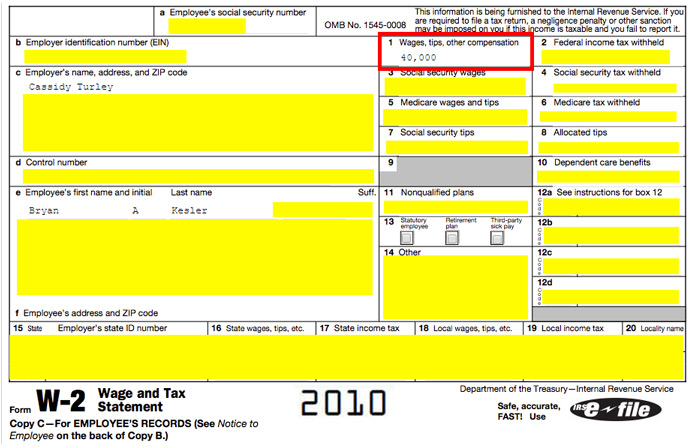
Since the position did not require a CPA, after I passed the CPA exam I obviously asked for a raise.
They weren't able to give me anything which meant I had to look outside the company for a job that paid me what I deserved.
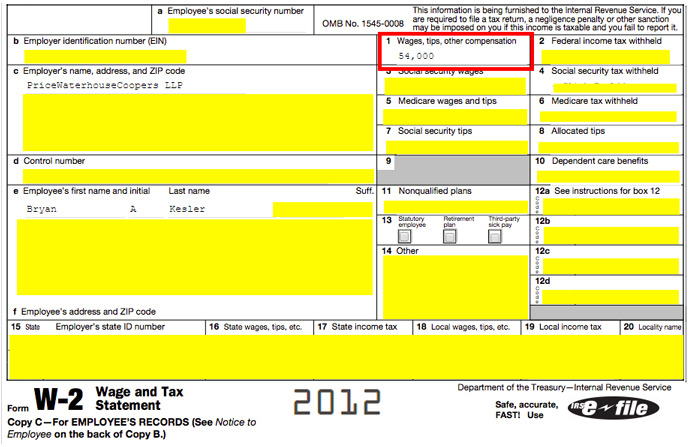
I put out my resume to all the major public accounting firms in my area and within a month I got an offer from PwC as an experienced associate making $54K.
A 35% jump in annual salary overnight just because I had 3 letters after my name!
After putting in my 2 years at PwC, I was able to quit and receive an offer for $65K per year as an assistant VP in the financial reporting department at CitiGroup in their mortgage business.
A 62.5% or $25K/yr jump in annual salary from my pre-CPA days!
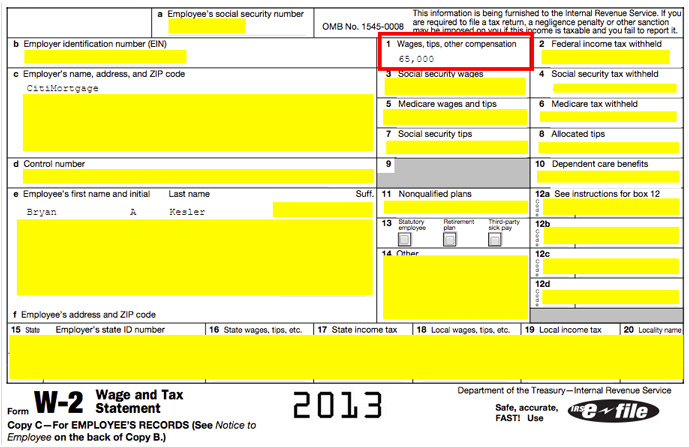
In just 2 years I increased my annual salary by $25K!
Do the math and over the next 30 years that $25K is going to turn into $750K and that doesn't include any additional raises or promotions that I will likely earn.
If I had not passed the CPA exam I can assure you that I would not have been making even $50K per year after 2 years.
Note: My W-2s above are from 2010-2013. Salaries have increased substantially since then. Let me show you what CPAs earn today.
CPA Salary in 2026: What Do CPAs Actually Earn?
My story happened over a decade ago. The salary numbers I shared were real, but the market has shifted significantly in favor of CPAs since then. Here is what the data says today:
| Source | Average CPA Salary | Notes |
|---|---|---|
| Bureau of Labor Statistics (bls.gov) | ~$119,000 | Median for accountants/auditors (CPAs skew higher) |
| PayScale (payscale.com) | ~$83,987 | Average across all experience levels |
| ZipRecruiter (ziprecruiter.com) | ~$91,980 | National average |
| Workday Salary Guide (2026) | $85K-$130K+ | Range varies by role and metro area |
Entry-level CPAs in 2026 typically start between $60,000 and $78,000 depending on the market and firm size. Compare that to non-CPA accountants who average around $50,000-$65,000. The gap is real and it widens every year as you gain experience.
CPA Exam ROI Breakdown
People hesitate because of the upfront cost. Fair enough. But let's do the math with 2026 numbers.
In 2026, major CPA review courses range from roughly $1,200 to $3,500+ (Becker's full package can exceed $3,000, while Kesler, Surgent, and Gleim fall in the $1,200-$2,000 range). Add in CPA exam application and testing fees of $800-$1,200, and your total investment is around $2,500-$5,000.
Now compare that against even a conservative $20,000-$35,000 annual salary premium. Use the calculator below to see your projected return:
📈 Your CPA ROI Calculator
That is not a typo. Even at the low end, the CPA exam is one of the highest-ROI professional investments you can make. And you are in control of the outcome.
What's Changed: The New CPA Exam Format
If you've been researching the CPA exam, you may have heard that things changed in 2024. Here's the short version: the CPA exam structure was overhauled under what AICPA calls "CPA Evolution."
The old four-section model (FAR, AUD, REG, BEC) is gone. BEC was retired entirely. In its place, the 2026 CPA exam follows a Core + Discipline model:
3 Core Sections (everyone takes these): FAR (Financial Accounting and Reporting), AUD (Auditing and Attestation), and REG (Taxation and Regulation).
1 Discipline Section (you choose one): BAR (Business Analysis and Reporting), ISC (Information Systems and Controls), or TCP (Tax Compliance and Planning).
The new format does not diminish the value of becoming a CPA. If anything, it allows you to specialize earlier and signal deeper expertise in the area that matters most to your career.
Current CPA exam pass rates hover around 50% overall. FAR remains the toughest section at 42-43%, while TCP has the highest pass rates at 73%+. Most candidates need 300-400 hours of total study time. It is challenging, but it is absolutely doable with the right CPA review course and study plan.
Important for 2026 candidates: The One Big Beautiful Bill Act (OBBBA), signed into law on July 4, 2025, includes tax provisions that become testable on REG and TCP starting July 1, 2026. Make sure your review course covers these updates.
The CPA Pipeline Crisis: Why Now Is the Best Time to Become a CPA
This is the single biggest reason the CPA exam is worth it right now. Fewer people are entering the pipeline, and demand for qualified CPAs keeps growing. That means less competition for you, more job offers, faster promotions, and higher salaries.
Public accounting firms are raising starting salaries, offering signing bonuses, and competing harder for CPA-licensed candidates than at any point in recent memory. If you are on the fence about whether to pursue the CPA, the supply-demand dynamics in 2026 are heavily in your favor.
Will AI Replace CPAs?
This is the question every CPA candidate in 2026 is asking. Here's the direct answer: AI is automating routine bookkeeping, data entry, and basic compliance tasks. It is not eliminating CPAs.
What AI is actually doing is shifting the CPA role toward higher-value work: advisory, interpretation, judgment calls, strategic planning, and complex compliance. These are exactly the skills that the CPA credential signals. Firms and companies need people who can make sense of what the software produces, not just run it.
The CPA designation tells employers you can think critically, work within regulatory frameworks, and exercise professional judgment. That is the opposite of what AI replaces.
The 150-Hour Requirement Debate
One of the top concerns for prospective CPAs in 2026 is the 150 semester-hour education requirement. Most states require 30 credit hours beyond a typical bachelor's degree, which often means a fifth year of school or a master's program.
This is a real barrier and the profession knows it. Several states are actively exploring alternative pathways that could reduce or restructure this requirement. There is an ongoing national debate about whether the 150-hour rule is contributing to the pipeline shortage.
Regardless of where the policy lands, the current reality is that the CPA exam requirements in most states still include 150 hours. Check your state's specific rules before planning your path. The investment of time and tuition is real, but the salary and career data above shows the return far exceeds the cost.
What You Need to Do to Get the Same Results
Now obviously I cannot guarantee specific results for you (I have to be upfront about that).
But if you do pass the CPA exam, I guarantee that if you want these results, you will find a way to accomplish them.
Passing the CPA exam will open doors for you that you didn't even know existed.
Best part is that these doors don't have to be in accounting.
I have friends who passed the CPA exam and now work for the FBI, are school teachers, and are now pursuing their PhDs.
Every industry recognizes that CPAs are determined people who are a cut above the rest.
It's a cliché, but it's actually true: if you can pass the CPA exam, you really can do anything you set your mind to.
Want To Pass The CPA Exam Fast?
BONUS: If you are interested in learning the step by step system I used to pass the CPA exam, join my Ultimate CPA Exam Guide for FREE and I will send you my CPA Exam Study Playbook, 100 multiple choice questions, and my CPA exam coaching video series!
Join for free here by taking our CPA exam study personality quiz: Ultimate CPA Exam Guide
Choosing Your CPA Review Course
Passing the CPA exam is all about which CPA review course you are using.
The number 1 mistake I see candidates all around the world making is trying to cheap out on a review course.
And I totally understand why. The majority of candidates are probably recently graduated or still early in their careers. Money IS an issue.
The good news is that based on how you study and learn best, you should expect to spend $1,200-$3,500 on a fully featured review course that gives you everything you need to pass. Many employers will reimburse part or all of this cost, so be sure to ask your firm or company about their CPA exam reimbursement program before paying out of pocket.
You can also check out my discount page to ensure you are getting the best price on the course that works for you:
Link: Best CPA Exam Review Course Discounts
Now while I never ordinarily recommend going into debt, you should NOT look at buying a review course as an expense but an investment.
Would you spend $2,500 on a review course if all it did was help you earn $25,000+ more per year every year for the rest of your career?
HECK YES you would!
Investing in yourself to pass the CPA exam is one of the MOST profitable investments any accountant can make. Best part is that you are totally in control of your destiny and not at the whim of Wall Street.
Regardless of whether you are brand new to the CPA exam process or are struggling to pass, you need to make sure that you are using the BEST CPA review course for you.
I recommend starting your research with my comparison of the best CPA review courses currently available.
Link: Compare Best CPA Review Courses Here
I reveal the inner workings of each course and provide you with my opinion on the pros and cons of each course.
Based on the features each course has, I recommend that you look at how you study and learn best and ensure the review course is going to amplify that strength.
What I mean by that is if you prefer to self-study and teach yourself the material, don't look at a course that has long lectures; pick one that focuses more on text and questions.
Or if you have a bit of ADHD, make sure that the course keeps you constantly moving between lectures, reading and questions so that you don't give yourself a chance to lose focus.
Does that make sense? If not email me at bryan@cpaexamguide.com and I would love to assist you in finding the best CPA review course for you.
You may also find these resources helpful as you plan your CPA journey:
CPA Exam Structure & Content | CPA Application Process | CPA Exam Requirements by State | CPA Pass Rates | Other Accounting Certifications (CMA, CIA, EA)
Frequently Asked Questions
CPAs earn 10-15% more than non-CPAs on average. In 2026, the average CPA salary ranges from $84,000 to $119,000 depending on the source, while non-CPA accountants average around $50,000-$65,000. Over a 30-year career, this gap can add up to $500,000 to $1,000,000+ in additional earnings.
Since January 2024, the CPA exam follows a Core + Discipline model. You take 3 core sections (FAR, AUD, REG) plus 1 discipline section of your choice: BAR, ISC, or TCP. The old BEC section was retired. Learn more about the current CPA exam structure.
The overall CPA exam pass rate hovers around 50%. FAR tends to be the hardest section at 42-43%, while TCP has the highest pass rates at 73%+. Most candidates need 300-400 hours of total study time. Check the latest CPA exam pass rates for section-by-section data.
Yes. AI is automating routine bookkeeping and data entry, but it is increasing demand for CPAs who can interpret results, advise clients, ensure compliance, and make judgment calls. The CPA credential signals you can do the higher-level work that AI cannot replace.
Total costs typically include $1,200-$3,500 for a CPA review course, $800-$1,200 in exam fees (varies by state), and potentially costs for additional education credits. Most candidates spend $2,500-$5,000 total. Many employers reimburse part or all of these costs.
Most states require 150 semester hours of education to become a licensed CPA, which is 30 hours beyond a typical 120-hour bachelor's degree. Several states are exploring alternative pathways. Check the CPA requirements for your state.
About Bryan Kesler, CPA
Bryan Kesler is a CPA Practice Advisor Top 20 Under 40, Licensed Certified Public Accountant, and founder of Kesler CPA Review. He passed the CPA exam in 2010 after overcoming 5 consecutive failures and has since helped thousands of candidates pass through his review courses, coaching, and free study resources. Read Bryan's full story | LinkedIn